
I have coached enough youth hoops and covered enough Friday nights to know this truth: the toughest kid on the field is often the one most willing to lie about a headache. That is exactly why high school football concussion protocol is built to take the decision out of the athlete’s hands and put it into the rulebook, the school policy, and a licensed clinician’s hands.
If you are a player, parent, or coach trying to understand what happens after a suspected concussion in high school football, here is the clean version. This is the NFHS rule baseline for removal, plus the state-association layer that schools must follow for clearance and return.
The standard schools follow
High school football in the United States generally uses NFHS (National Federation of State High School Associations) playing rules. On top of that, each state’s high school athletic association (and often state law) sets the required concussion procedures for evaluation, clearance, and return-to-play.
Here is the framework you will hear in almost every stadium:
- NFHS playing rules drive in-game removal when a player shows signs, symptoms, or behaviors consistent with a concussion or head injury.
- Your state association policy drives medical clearance and return-to-play, including who can clear the athlete and how the step-by-step progression must be documented.
In plain terms, the rulebook gets them out, and your state policy dictates how they get back.
Step 1: When in doubt, out
Under NFHS rules, if a player shows signs, symptoms, or behaviors consistent with concussion, that athlete must be removed from play immediately. It does not matter if it is playoffs, senior night, or the player says they are “fine.”
To put a simple definition on it: a “suspected concussion” is when concussion is a reasonable concern after a blow to the head or a hit to the body that snaps the head, followed by symptoms or a player just not acting right.
Who can trigger removal?
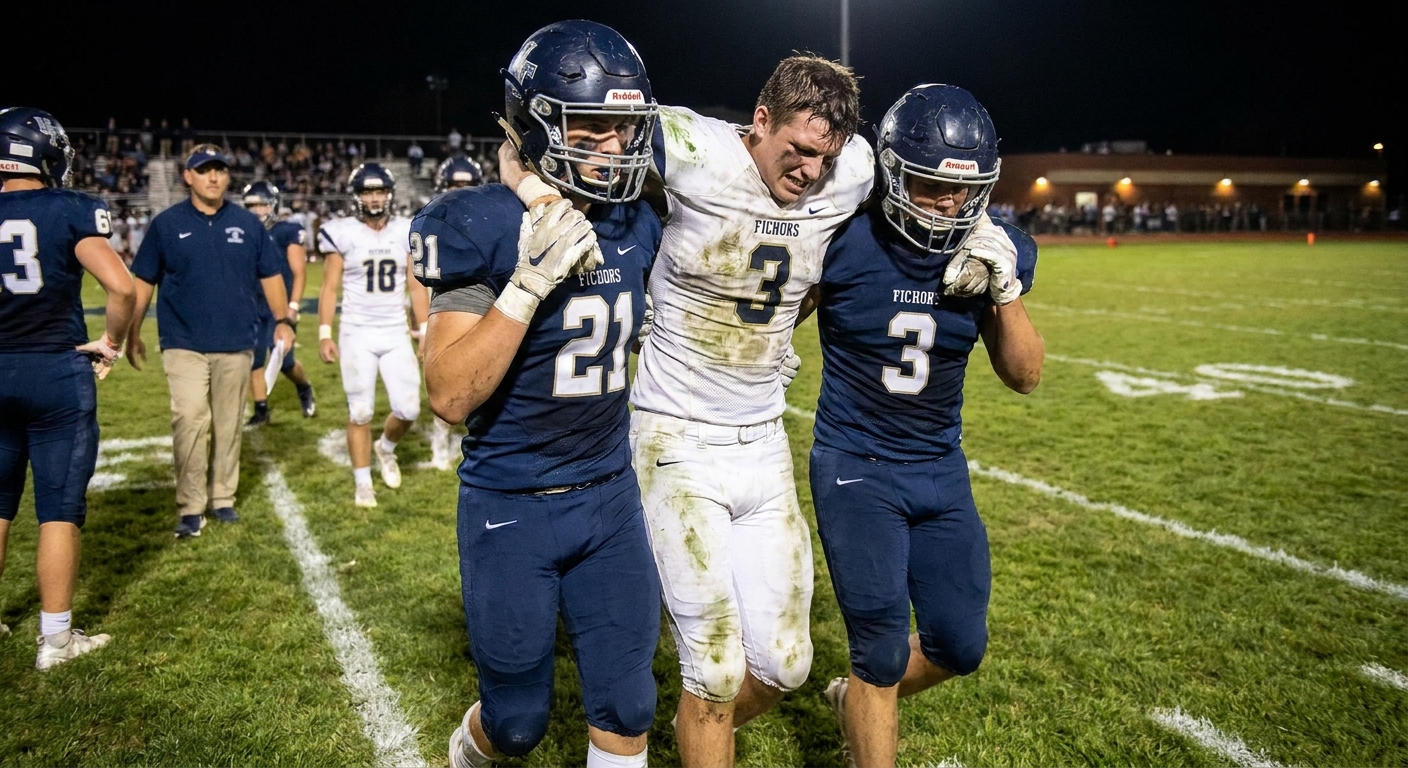
On most high school sidelines, removal can be initiated by game officials, an athletic trainer, a team physician, or coaching staff based on what is observed or what is reported. And yes, athletes, teammates, and parents matter here too, because symptoms get reported, not just spotted.
Same-day return is often not allowed
Many states, through state law or athletic-association policy, prohibit same-day return after a suspected concussion. Even where the language varies, the practical outcome is similar at most schools: if concussion is suspected, that athlete is typically done for the night.
What happens right after removal
In most programs, the athlete is moved to a quiet spot, checked by the athletic trainer or medical staff if available, and a parent or guardian is notified with home monitoring instructions. The goal is not to “pass a quick test.” The goal is to keep the player safe and identify whether this needs urgent medical care.
Red flags: when to seek urgent care
If symptoms are severe or worsening, treat it like an emergency. Common red flags include worsening headache, repeated vomiting, seizure, increasing confusion or agitation, inability to wake up, slurred speech, weakness or numbness, neck pain, or unequal pupils. When in doubt, get evaluated right away.
Step 2: Sideline screening is not clearance
This is where families get tripped up. A coach cannot “watch you for a series” and send you back in. And a parent cannot override the protocol with a quick pep talk.
Here is the more precise truth: sideline screening tools can help identify a problem, but they cannot rule out concussion. Clearance has to follow your state law and state-association policy, and many states do not allow same-day return once concussion is suspected.
Who may clear the athlete?
The exact job titles allowed to provide clearance vary widely by state. Some states limit final clearance to an MD/DO (and sometimes an NP/PA). In other states, an athletic trainer may be involved in the process but not be the final clearance authority. Neuropsychologists may contribute testing, but are not always the clinician recognized for clearance.
Common possibilities you may see in state policies include:
- A medical doctor (MD) or doctor of osteopathic medicine (DO)
- A nurse practitioner (NP) or physician assistant (PA) when explicitly allowed
- A licensed athletic trainer (AT) in states that permit their clearance role under the required supervision or standing orders
- A neuropsychologist or other specialist as part of evaluation and management in states that include them
The key is not the acronym. The key is this: the school must follow the state-association clearance standard, and most schools require written clearance on a specific form or letter before the athlete can progress back to contact.
Baseline testing is optional
Some schools use baseline neurocognitive testing (like ImPACT or similar tools). It can be helpful, but it is not required everywhere, and it is not a stand-alone diagnosis. A concussion is diagnosed clinically.
Step 3: Return-to-play is step-by-step
One of the biggest misconceptions I hear on bleachers is that clearance means, “He is good to go Friday.” In reality, most state associations use a graduated return-to-play (RTP) progression based on consensus sports medicine guidance, with school oversight and documentation.
While details vary, the typical high school pathway looks like this:
RTP steps
- Symptom-limited activity: Light daily activity that does not worsen symptoms.
- Light aerobic exercise: Easy bike, walk, or jog. No lifting, no contact.
- Sport-specific exercise: Football movement work like jogging routes or footwork. Still no contact.
- Non-contact training drills: More complex drills, possible light resistance training. No contact.
- Full-contact practice (only when allowed by state policy and medical clearance): Controlled return to contact in practice settings.
- Return to competition: Full participation in games.
Timing is where families get surprised. Protocols typically require at least 24 hours between stages, and if symptoms return, the athlete usually drops back to the previous symptom-free stage and tries again later. Some states also require minimum day timelines (multi-day, or longer) regardless of how quickly symptoms fade, so the calendar is not always negotiable.
What schools track
At the school level, concussion management is not just medical, it is administrative. A solid high school program documents:
- Date and mechanism of injury and observed signs
- Removal-from-play confirmation and who initiated it
- Parent notification and home monitoring guidance
- Medical evaluation notes and written clearance documentation as required
- RTP step progression, including dates and symptom checks
- Final authorization for full-contact practice and game return
If your school has an athletic trainer, they are often the hub connecting family, coaches, and the clinician providing clearance. If there is no athletic trainer, the school or district typically has a designated concussion policy coordinator.
Common questions
Can a player return the same game after “passing” a quick test?
In high school football, that is often not permitted by state policy, and it is rarely a good idea. A sideline screen can help identify a problem, but it cannot erase suspicion or “rule out” concussion. If concussion is suspected, the safe default is removal and medical evaluation under your state’s rules.
What if the hit looked minor, but the player seems off later?
Concussion signs can be delayed. Treat a late-developing headache, dizziness, confusion, sensitivity to light, or unusual behavior as a serious red flag and report it to the school immediately.
Is a helmet sensor or mouthguard sensor enough to clear someone?
No. Impact sensors can flag a concerning hit. They cannot diagnose a concussion or provide clearance. Clearance must follow the state-association medical clearance standard.
Does school support happen too?
Often, yes. Many schools pair return-to-play with “return-to-learn” supports, because symptoms can flare with reading, testing, screens, and noisy hallways. That coordination may run through an athletic trainer, school nurse, counselor, teachers, and sometimes a 504 plan process depending on the case and the district policy.
The bottom line
High school football concussion protocol is designed to do one thing well: stop a potentially injured brain from taking another hit.
- Under NFHS rules, signs or symptoms consistent with concussion mean immediate removal.
- Return requires written clearance from the type of licensed health care professional your state association policy allows.
- Getting back to football happens through a graduated return-to-play progression, with timelines that can be longer than a week depending on symptoms and state minimums.
As someone who loved the game as a player and loves it even more now as a storyteller and coach, I will tell you what I tell every teenager I work with: the season is long, your brain is longer. Protect it.