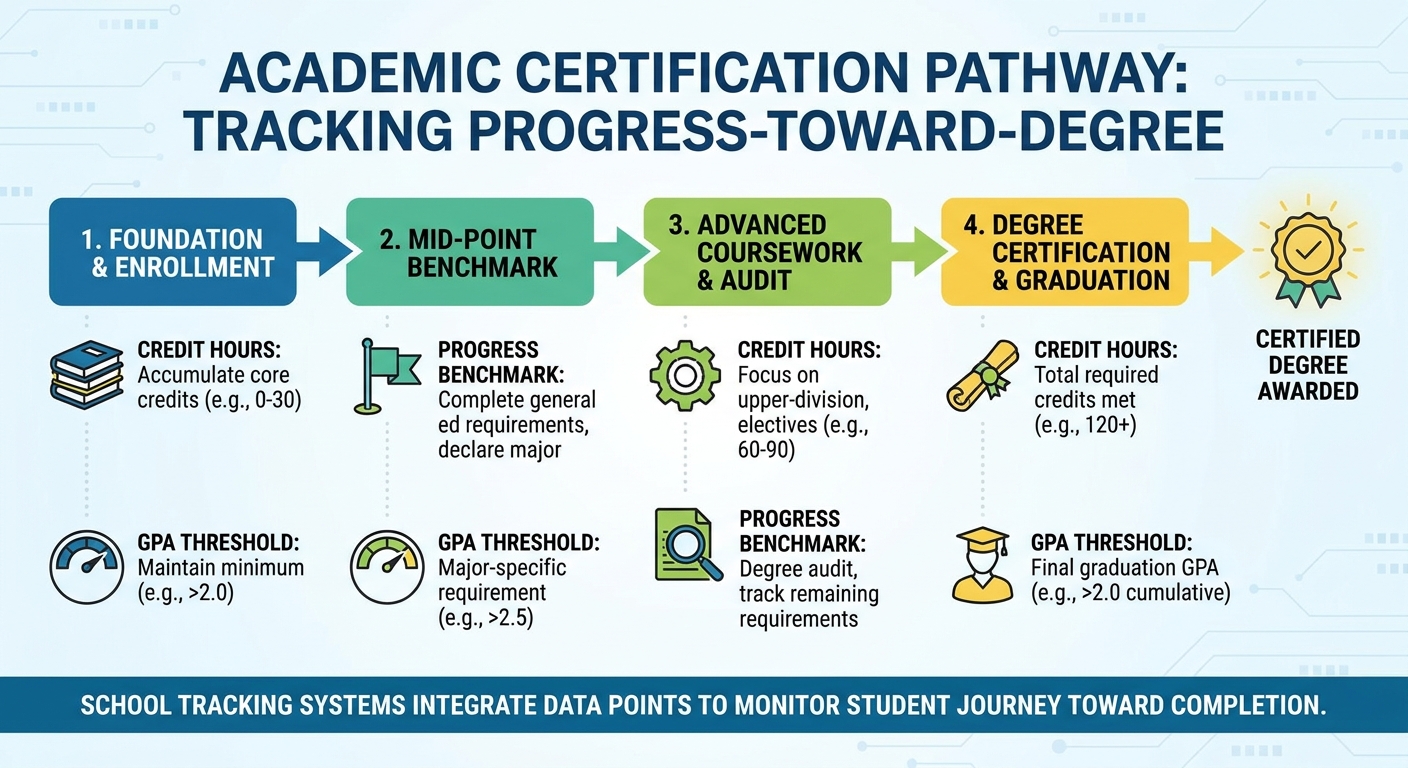
I have sat in enough gym hallways and compliance offices to know this: when a player hits the portal, everyone talks about fit, minutes, and NIL. The quiet deal-breaker is often academic. The NCAA calls it progress-toward-degree, and it is basically the rulebook’s way of saying, “If you want to keep playing, you have to keep moving toward your diploma.”

Below is what the rule means in plain English, the benchmarks transfers often need to hit to be eligible to compete (if all other requirements are met), and where transferable credits can help or hurt. I am keeping this focused on eligibility standards, not the registrar question of whether a course shows up on a new transcript.
What PTD means
Progress-toward-degree (PTD) is the NCAA’s academic eligibility framework for continuing students. Once you enroll full time at a college, the NCAA expects you to:
- Earn enough credit hours each term and each year.
- Maintain an acceptable GPA under NCAA and school rules.
- Complete a required percentage of your degree as you move into your later years (Division I uses the well-known percentage benchmarks).
If you transfer, the NCAA does not reset you to year one. Your new school has to certify that, based on what you have earned and what can be applied to your degree path, you are still on pace.
One important clarity that gets lost online: your school certifies eligibility. The NCAA writes the rules, but the day-to-day “yes, you can compete” comes through the institution’s compliance and academic certification process.
Also, PTD is necessary for eligibility, but it is not always sufficient. Transfer eligibility can involve other layers (conference rules, sport-specific legislation, timing, exceptions, waivers, and more), and PTD is just one of the big ones. Outcomes can change based on sport, midyear enrollment, your school’s academic calendar, and the institution’s certification timeline.
The key checkpoints
Think of PTD like a three-legged stool. If one leg is short, your eligibility wobbles.
1) Credit-hour minimums
At the Division I level, there are a few PTD pace markers that come up constantly in compliance conversations. Because readers treat these numbers like gospel, I want to label them correctly: what follows is informal shorthand you hear around athletics buildings. It is not a substitute for the current NCAA bylaw language, sport-specific legislation, conference rules, or your school’s certification timeline.
One more layer of protection before anyone starts doing portal math on a napkin: your school applies the NCAA’s current definitions to your exact enrollment history. That includes what counts, the timing windows, and any exceptions. Do not self-calculate eligibility from these shorthands.
Depending on your sport, entry point (midyear matters), and enrollment pattern (quarters and summers matter), people often reference a mix of term-to-term and year-to-year pace concepts, including:
- 6 semester hours each term (often expressed as 9 quarter hours at quarter-system schools). This is commonly talked about as a term-to-term pace idea. Whether it applies in your case, and what counts toward it, is fact-specific.
- 18 semester hours (or 27 quarter hours) across an NCAA-defined academic window that compliance staff may use in certain continuing-eligibility certifications. That “window” is technical and can be counterintuitive. It is one reason schools rely on current definitions and interpretations instead of memory.
- 24 semester hours (or 36 quarter hours) as a commonly cited annual pace target. How summer coursework is counted, how midyear enrollment is treated, and how full-time terms are defined can all change the real-world math.
Those numbers sound simple until you are a transfer and a chunk of your credits do not apply cleanly to your new degree program. That is where the “transferable credits” piece becomes the whole story.
One definition that clears up a lot of confusion: earned hours are credits you passed and received. Degree-applicable hours are credits your new school will count toward your designated degree program for PTD certification. Transfers get in trouble when they assume those are the same thing.
One more thing that matters in real life: “transferable” is not always the same as “degree-applicable.” A course can transfer in and still not count toward your specific major, concentration, or your degree’s required buckets. For PTD, that difference can be everything.
Also, athletes and families mix up three different questions: practice, competition, and financial aid. PTD is most often discussed in the context of competition eligibility, but a school, conference, or team can have separate (additional) standards for practice status and aid. Those extra standards can be stricter than the NCAA floor. What they cannot do is override NCAA rules and make someone competition-eligible if NCAA competition eligibility is not met. And if your conference has its own transfer or eligibility requirements, a school cannot just relax those either. Always confirm which status you are actually asking about when you talk to compliance.
2) Degree progress (40/60/80)
In Division I, once you get past the early part of your college career, you have to show you are completing a meaningful portion of your declared degree program on schedule. The benchmarks you always hear are:
- 40% at an NCAA-defined certification checkpoint tied to a specified number of full-time terms of enrollment.
- 60% at the next NCAA-defined certification checkpoint tied to additional full-time terms.
- 80% at the next NCAA-defined certification checkpoint tied to additional full-time terms.
These are calculated at specific certification points, and they are based on hours applicable to your designated degree program. In normal human language: you have to pick a major on time, and your credits have to count toward it.
One practical clarification: these checkpoints are tied to how many full-time terms you have actually enrolled, not just what academic “year” you feel like you are in. Semester versus quarter systems, midyear enrollment, and any nontraditional enrollment pattern can shift when your school has to test you against the next percentage mark.
3) GPA (the part nobody wants to talk about)
The NCAA does not treat GPA as a vibes-based concept. For continuing eligibility, the NCAA sets minimum GPA expectations using its eligibility scale. Schools can add additional academic standards, but they cannot be less stringent than the NCAA minimum for NCAA eligibility.
Translation: even if the credits work, you still need a GPA profile that clears the NCAA layer and the campus layer at the new school. And if your GPA is hovering near the line, transferring can be risky because you are stepping into a new academic environment with different course demands, plus the pressure of a new team and system.
How credits affect PTD
Here is the cleanest way I can say it: credits only help your progress-toward-degree if they count toward your degree plan.
For a transfer, the academic certification process is essentially asking:
- How many degree-applicable credits does the athlete have right now for the declared program?
- Do those degree-applicable credits keep the athlete on pace for the credit-hour minimums and the percentage benchmarks?
- Is the athlete’s GPA sufficient under NCAA, conference, and institutional rules?
This is why two athletes can transfer with the same number of total credits and end up in totally different situations. One lands in a program where most courses plug into the new major. The other changes majors or moves into a stricter degree map and suddenly 12 to 30 hours are real college credits but not helpful for NCAA PTD certification.
Important nuance: this is not about whether a course appears on a transcript at the new school. It is about whether the credits can be used to show degree progress at the pace the NCAA requires.
Transcript and accounting gotchas I see come up in transfer PTD reviews:
- Remedial or non-degree credit can be real time and real tuition without helping PTD.
- Repeats can raise a grade but often do not add new earned hours the way athletes assume.
- Pass/fail classes can fail to count toward major requirements, even if they count toward overall hours.
- Incompletes and withdrawals can leave you short on term or annual pace until final grades and credits post.
- Campus policies vary on grade replacement, repeats, and what counts as degree-applicable. Two schools can look at the same transcript and apply it differently to a degree map.
What trips up transfers
When I talk to coaches, the PTD red flags they mention are surprisingly consistent. Transfers run into trouble when they make planning choices that do not travel well:
- Changed majors multiple times, even if their overall GPA is fine.
- Built schedules around electives instead of a degree map that keeps them moving through requirements.
- Delayed declaring a major and then discovered the new program has a tight course sequence.
- Picked a new major that is not transcript-friendly for their existing credits, so “earned” hours do not translate into “degree-applicable” hours.
- Transferred late and had limited options for summer coursework to catch up.
None of this is a character judgment. It is just math and policy, and the policy does not care that you were switching schemes, rehabbing an ankle, or learning a new city.
Division I vs II vs III
Most of the headline PTD talk you hear is Division I because the percentage benchmarks are widely cited and the compliance infrastructure is huge. But the big idea carries across divisions: you must be enrolled properly, meet baseline NCAA requirements for your division, and stay in good standing under your institution’s certification process.
- Division I uses the well-known percentage-of-degree benchmarks (40/60/80) alongside credit-hour and GPA requirements.
- Division II has its own progress-toward-degree and continuing-eligibility requirements, including credit and GPA standards, but the exact benchmarks and certification approach differ from Division I.
- Division III does not use the Division I 40/60/80 structure. Eligibility still includes NCAA baseline expectations (including enrollment and credit-hour related requirements), plus the institution’s academic standing standards. Conferences can add their own layers depending on the league.
If you are a transfer, do not assume what your friend at another level went through applies 1:1 to you.
A quick example
Picture a junior transfer in a 120-hour degree program. Under the 40% benchmark, they need 48 degree-applicable hours by the point the NCAA measures the 40% requirement.
Now picture that athlete has 60 total semester hours. On paper, that looks like two years done. But if only 45 of those hours apply toward the new degree program, then:
- They may be behind on the 40% requirement.
- They may struggle to map a plan that hits term-by-term credit pace while also taking the right major courses.
- They might need summer classes just to get back on track.
This is why athletes hear “you might have to sit” even when they have been in school for two years and feel like they did everything right.
FAQ
Does PTD apply the moment I transfer?
It applies as part of your eligibility certification at the new school. The compliance and academic certification staff have to confirm you meet continuing-eligibility standards, including PTD, before you can compete.
If I have enough total credits, am I automatically fine?
No. The issue is not just total credits earned. It is degree-applicable credits toward your declared program, your pace by term and year, and whether you satisfy percentage-of-degree and GPA requirements.
What is the biggest PTD mistake transfers make?
Assuming eligibility is only about admissions. You can get admitted and still be behind on progress-toward-degree once your credits are evaluated against your new degree plan.
Can summer school fix PTD issues?
Sometimes, yes. Summer coursework is one of the most common ways athletes make up needed hours or catch up to a percentage benchmark. Whether it works depends on what classes are available, how the NCAA counts them in your situation, and whether they apply to your program.
Who should I talk to first?
If you are in the portal and trying to project eligibility, the best sequence is usually compliance and academic advising at the potential new school, with your current school’s academic support staff helping you gather clean records. Coaches can advocate, but they cannot certify.