
When you watch your kid play football, you sign up for the noise, the nerves, and the occasional bruise. What none of us want is the scary moment where a hit looks "off" and your child stands up a little slower than usual.
Concussions are not always obvious, and they do not always show up right away. The good news is that youth football has gotten much better about taking head injuries seriously. The even better news is that parents who know what to look for can make the difference between a smooth recovery and a situation that gets worse.
This is a parent-friendly walkthrough of what typically happens after a suspected concussion: what coaches and athletic trainers do on the sideline, what you should watch for over the next 24 to 48 hours, and how return-to-play usually works. It is not a diagnosis tool. When in doubt, get medical care and keep your athlete out.
Based on: CDC HEADS UP guidance and current sports medicine consensus on concussion care and gradual return to activity.
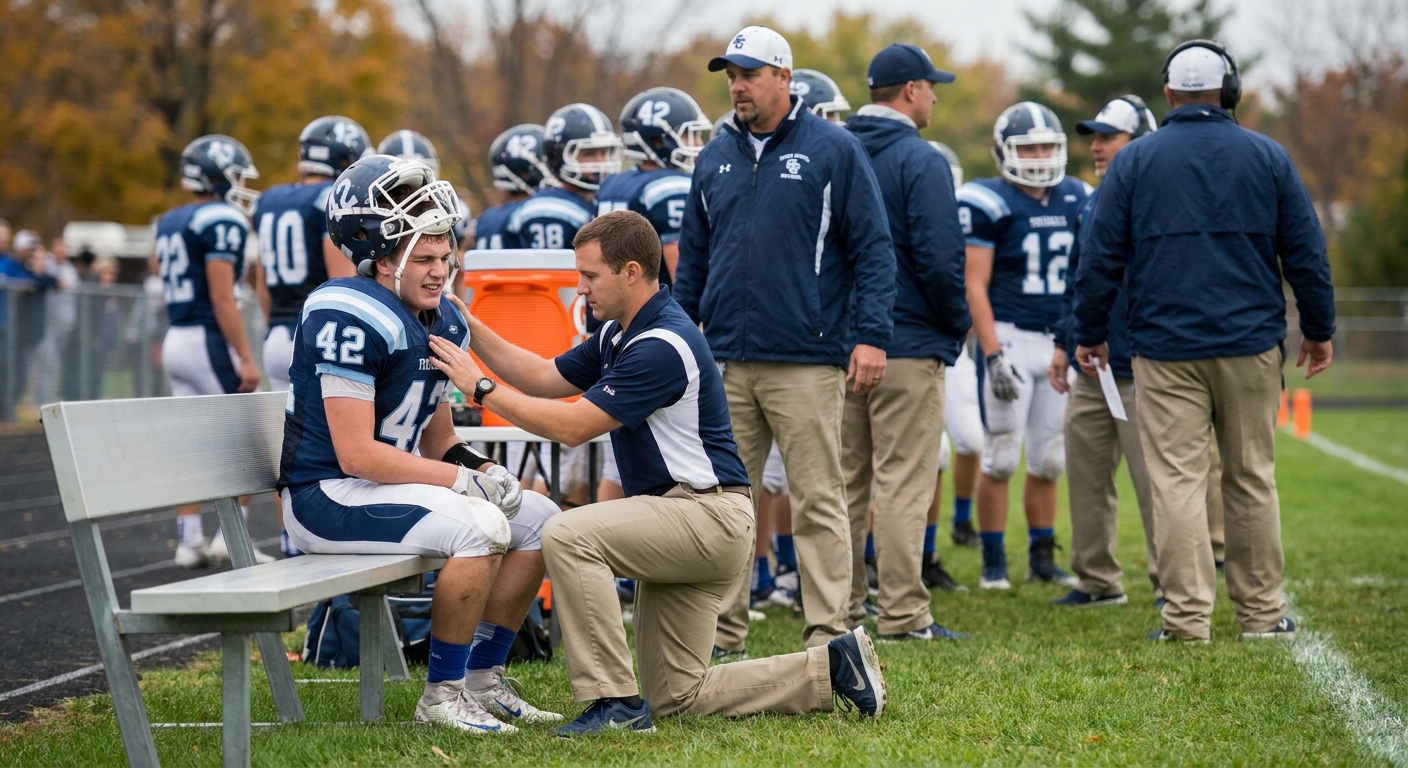
What counts as a suspected concussion?
A concussion is a brain injury caused by a bump, blow, or jolt to the head or body that makes the brain move quickly inside the skull. In youth football, that can happen on a tackle, a fall, helmet-to-helmet contact, or even a whiplash-style hit where the head snaps back.
Here is the key for parents: a concussion can happen even if your child never loses consciousness. In fact, most concussions do not involve loss of consciousness.
Common game signs
- They look dazed, stunned, or "not themselves" after contact
- They are slow to get up, or they hold their head
- They forget the play, the score, or where they are supposed to line up
- They seem unusually emotional, irritable, or confused
- They move awkwardly, lose balance, or stumble
If any of that happens, treat it like a suspected concussion until a medical professional says otherwise.
What should happen on the sideline
In many youth leagues and in most U.S. states with youth concussion laws, the backbone is the same: when a concussion is suspected, the athlete is removed from play immediately. No “shake it off” series. No “one more snap.”
Step 1: Remove from play
The safest decision is the simplest one. A second hit before the brain has healed can significantly worsen symptoms, extend recovery, and in rare cases can lead to serious complications. Even if your child insists they are fine, they should sit.
Step 2: Sideline check
If an athletic trainer or qualified medical professional is present, they may do a structured assessment. If not, coaches may use their league’s concussion checklist and observe symptoms. The goal is not to “clear” your child for same-day return on the sideline. The goal is to identify concerns and keep them safe.
Expect questions like:
- What day is it? What quarter is it?
- Who are we playing?
- What was the last play you remember?
- Do you have a headache, nausea, dizziness, or blurry vision?
Step 3: Parent update
You should be told that a concussion is suspected and that your athlete is done for the day. Ask what was observed and when symptoms started. If the league has a written concussion protocol, request it or look it up later so you know what documentation they will require for return-to-play.
Parent sideline rule: Ask questions and get clarity, but support the decision to pull them. If an adult on the field saw something concerning, sitting out is the right call.

Signs to watch for at home
Some symptoms show up immediately. Others creep in later that night, the next morning, or when your child tries to read, use a screen, or go back to school.
Physical symptoms
- Headache or pressure in the head
- Nausea or vomiting
- Dizziness or balance problems
- Sensitivity to light or noise
- Blurry or double vision
- Fatigue, low energy, or appearing “washed out”
Thinking and school symptoms
- Confusion, feeling “foggy,” or slow processing
- Trouble concentrating or remembering
- Taking longer to answer questions
- Headache that worsens with reading, homework, or screens
Mood and behavior symptoms
- Irritability, sadness, anxiety, or unusual emotional swings
- More clingy than normal (especially in younger kids)
- Uncharacteristic anger or agitation
Sleep symptoms
- Sleeping more than usual or having trouble falling asleep
- Waking up frequently
- Feeling drowsy all day
If you are tracking symptoms, write down what you see, when it happened, and what seemed to trigger it (car ride, bright gym lights, math homework, video games). That log is extremely helpful for a clinician.
Red flags: get emergency care
Most concussions can be managed with prompt evaluation and the right plan. Still, it is important to know the few signs that should move you from “monitoring” to “go now.”
If you see any of the following, seek emergency care immediately or call your local emergency number:
- Repeated vomiting
- Worsening or severe headache
- Seizure activity
- Increasing confusion, agitation, or unusual behavior you cannot calm
- Slurred speech
- Weakness, numbness, or coordination that is getting worse
- One pupil larger than the other
- Unable to recognize people or places
- Loss of consciousness, even briefly
- Can’t be awakened, or is progressively harder to wake
- Neck pain with neurological symptoms after a hit
If your gut says something is wrong, treat that as a red flag too. It is always better to be the “overly cautious” parent than the parent wishing they had gone in sooner.
What to do in the first 24 to 48 hours
1) Get a medical evaluation
Arrange an evaluation with a healthcare professional experienced in concussion care, especially if symptoms are persistent, worsening, or affecting school. Even when symptoms seem mild, an assessment helps guide a safe return to school and sports.
2) Prioritize relative rest
Old-school advice used to be “sit in a dark room for days.” Current approaches often emphasize relative rest early on, then a gradual return to light activity as tolerated and directed by a clinician.
In practical terms, that usually means:
- Keep the day calm: no practice, no PE, no rough play
- Limit activities that spike symptoms (often screens, loud environments, intense reading)
- Light movement like an easy walk may be okay if it does not worsen symptoms and your clinician agrees
3) Protect sleep and observe
Sleep is recovery. Follow your clinician’s instructions. Many kids do not need to be kept awake, but some clinicians recommend a period of observation first, and you should follow any urgent care or ER discharge instructions about checking in overnight and when to wake them.
4) Tell the school
Concussions affect learning too. Notify the school nurse, teacher, and coach. Your child may need short-term adjustments such as reduced screen time, extra time on assignments, breaks, or a lighter workload.
What to expect at the doctor
A good concussion visit is usually more about the story and the exam than a fancy test.
- History: what happened, prior concussions, headaches or migraines, learning differences, sleep, and current symptoms
- Neuro check: memory, focus, eye tracking, reaction, speech
- Balance and coordination: simple balance tasks and walking checks
- Symptom scales: a way to track what is improving and what is not
Imaging like a CT scan is not routinely needed for a typical concussion. It is usually reserved for cases with red flags or concern for a more serious injury. Your clinician will also tell you what activities are safe now, what to avoid, and when to follow up.

Return-to-play steps
Return-to-play is not a single moment. It is a step-by-step progression that should happen only after your athlete is improving and has medical clearance as required by your league or state rules.
Protocols vary by organization, but most follow a graduated plan where the athlete moves forward only if symptoms do not return or worsen. If symptoms come back, the athlete drops back to the previous step and rests.
Typical progression
- Symptom-limited activity: light daily activity that does not worsen symptoms.
- Light aerobic exercise: easy bike or walk, no resistance training, no contact.
- Sport-specific exercise: football movement without contact, like light running and footwork.
- Non-contact drills: higher intensity, more complex drills, still no contact.
- Full-contact practice: only after medical clearance and only in a controlled setting.
- Return to game play.
Many programs require at least 24 hours between stages, and some require longer. The big idea is simple: the brain needs time, and symptoms are information.
One hard truth I tell families as a coach: A kid can be conditioned back into shape. You cannot hustle your way through brain healing.
School comes first
As a general rule, you want a solid return-to-learn before full-contact return-to-play. If your child’s symptoms flare up during class, they are not being dramatic. Reading, note-taking, bright lights, and noisy hallways can all crank up symptoms.
Common supports
- Partial attendance or a shortened school day for a few days
- Breaks in a quiet area when symptoms rise
- Reduced homework load or extended deadlines
- Limiting screen-based work temporarily
- No PE, weight room, or recess contact until cleared
Your clinician can provide guidance or documentation for the school. In a lot of families, getting school steady again is the quickest path to getting sports back safely.
Baseline testing
You may hear about baseline concussion tests (often computerized). They can be a helpful tool in some programs, but they are usually optional, not required, and not a substitute for a clinical evaluation. If your league offers it, ask how they use it, who interprets it, and what happens when the test does not match how your child feels.
Parent checklist
On the sideline
- Confirm your child is removed from play and will not return that day
- Ask what symptoms were observed and when
- Keep your child calm and away from chaotic stimulation if possible
- Do not let them drive (for older teens) or ride home alone
That night and next day
- Monitor symptoms and write them down
- Watch for red flags and seek emergency care if they appear
- Schedule a medical evaluation
- Notify school and request temporary adjustments if needed
- No same-day return to sport, no roughhousing, no trampoline, no “testing it out”
Before returning to football
- Follow your league’s written return-to-play rules
- Get required medical clearance documentation
- Progress step-by-step, stopping if symptoms return
- Aim for full school demands before full-contact football, when advised
FAQ
Can my child have a concussion without a head hit?
Yes. A forceful hit to the body can whip the head and jolt the brain enough to cause a concussion.
Should my child take medicine for a headache?
Ask your healthcare professional what is appropriate for your child and when. Do not use medication to “mask” symptoms so they can be active.
What if my child seems fine later and wants back in?
No. Same-day return-to-play after a suspected concussion is widely discouraged and often prohibited by league policy or state law. Symptoms can be delayed, and risk goes up if another hit happens before the brain recovers.
How long does recovery take?
It varies. Some kids improve within days, others take weeks. Prior concussion history, migraine history, learning differences, sleep, and the specifics of the injury can all affect recovery. Your clinician should guide the timeline.
One last note
I love tough kids. I also love kids who grow up healthy enough to keep playing whatever they love. If your child takes a shot and something feels off, you are not soft for speaking up. You are doing the job.
When in doubt: sit them out, get them checked out, and let the comeback be the story.