
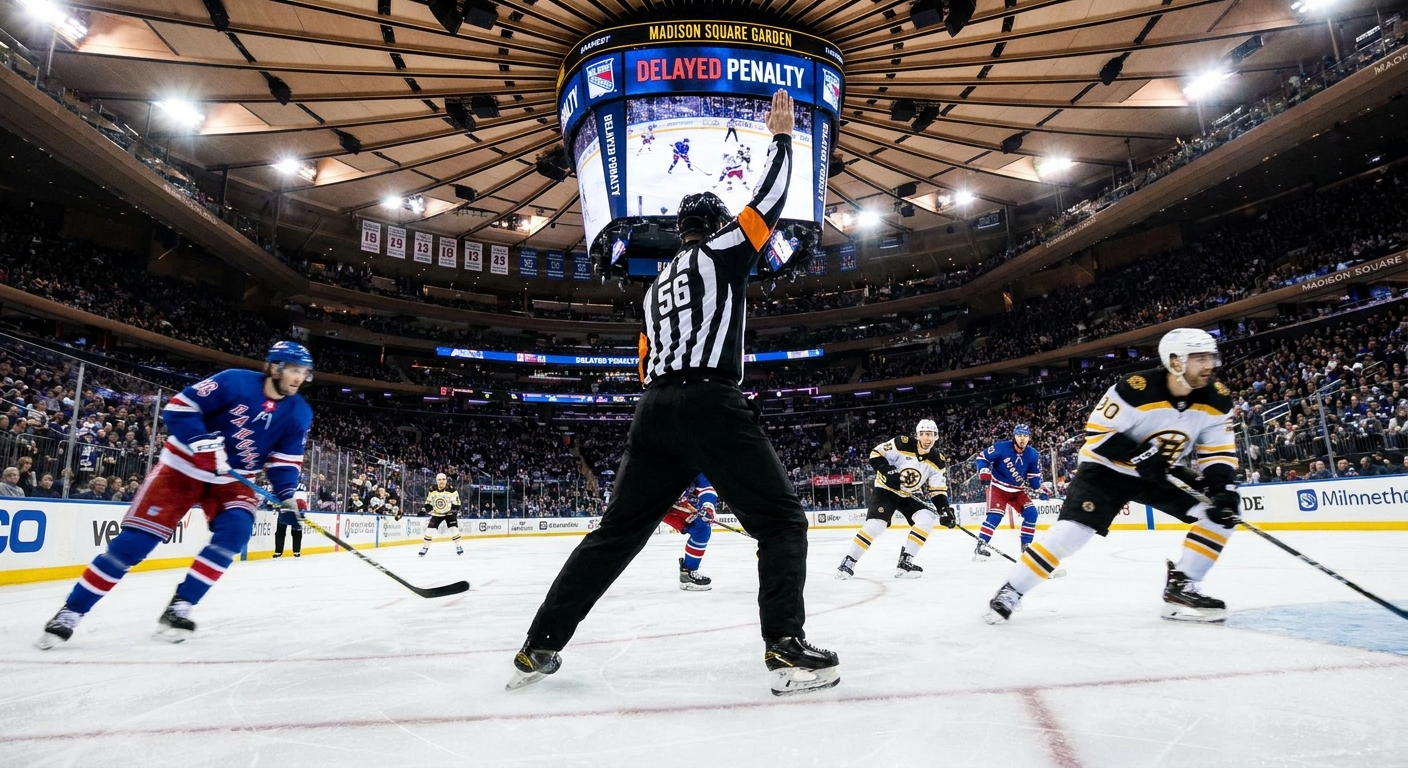
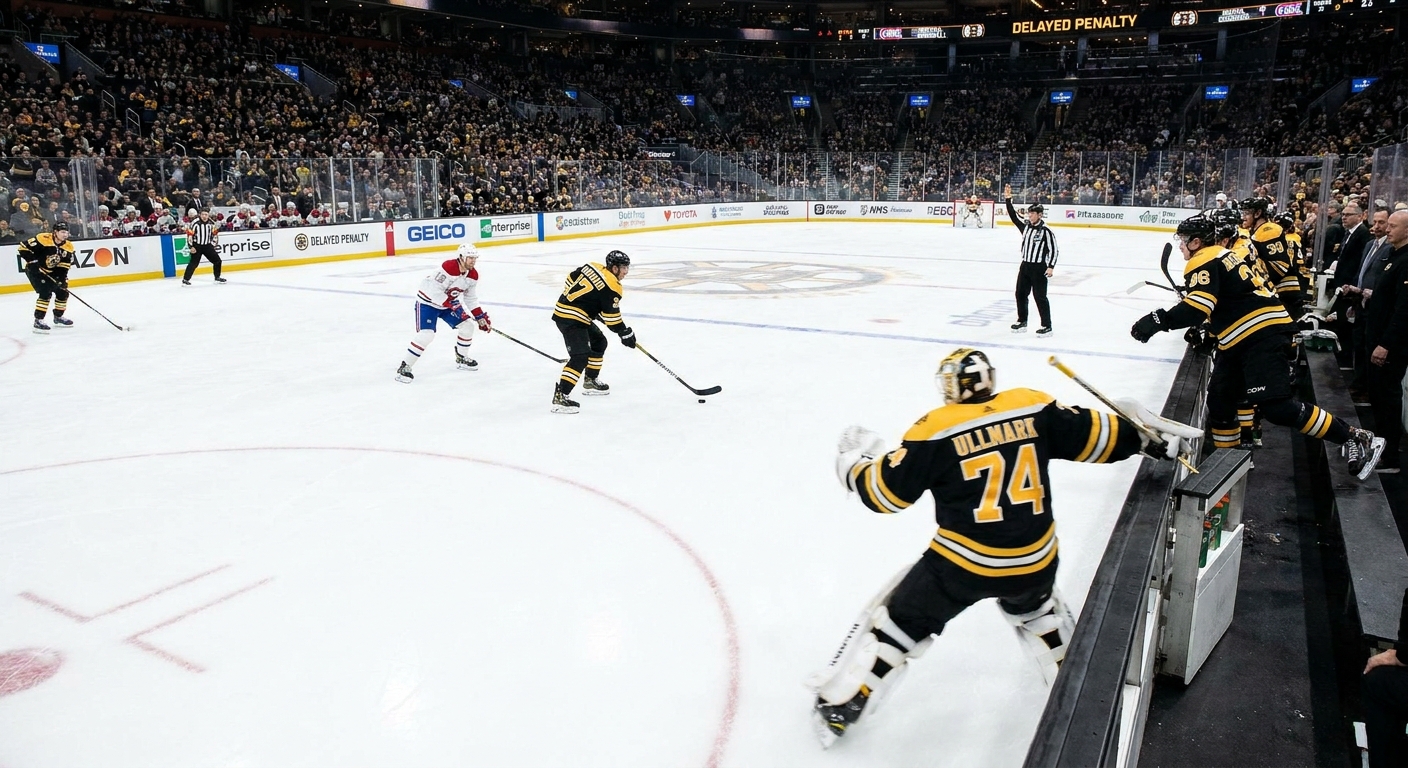
The first time you see it live, a delayed penalty feels like hockey decided to turn the chaos knob all the way up. The ref’s arm shoots straight up, nobody stops, the crowd starts buzzing, and suddenly the goalie is racing to the bench like it’s a fire drill.
But there’s a method to it. A delayed penalty is one of the cleanest examples of hockey trying to be fair to the team that got fouled while keeping the game moving.
What a delayed penalty means
A delayed penalty happens when a player commits a foul, the referee signals a penalty, but play does not stop immediately.
Instead, the game continues until one specific thing happens: the team that committed the foul (the offending team) gains control of the puck. The moment they touch and control it, the whistle blows and the penalty is enforced.
Why allow play to continue? Because the team that was fouled often still has the puck and an attacking opportunity. Stopping play right away would erase that chance.
The key trigger: when the whistle actually blows
Here’s the simplest way to remember it:
- Ref’s arm up means a penalty is coming.
- No whistle yet because the non-offending team has the puck or is likely to get it.
- Whistle blows when the offending team touches and gains possession/control of the puck.
That “control” piece matters. A puck can ricochet off a skate or stick in a scramble. Officials typically wait for clear possession by the offending team before killing the play.
What counts as possession?
In real game flow, think of possession as: the offending team can reasonably make a play with the puck. If they chip it away immediately or it just deflects off them, the official may let it continue.
Why the goalie leaves: the extra-attacker advantage
This is the fun part, and it’s also where you’ll hear broadcasters say, “They’ve got a free play here.” During a delayed penalty, the non-offending team knows the whistle will only come if the other team gets the puck.
So they’ll often pull the goalie for an extra attacker, creating a temporary 6-on-5 in the offensive zone.
It’s a calculated risk, but the logic is strong:
- If the offending team ever gains control, play is whistled dead anyway.
- With an extra skater, you boost your odds of creating a high-quality chance before that happens.
What happens if a goal is scored during the delay?
If the non-offending team scores a goal before the whistle, the delayed penalty usually ends right there.
In most standard situations, that goal effectively replaces the power play you were about to receive.
So does the penalty disappear?
Most of the time, yes. If the delayed penalty was going to be a minor (two minutes) and you score during the delayed situation, the minor is typically wiped out and the game resumes at center ice with the faceoff after the goal.
But hockey always has a couple wrinkles:
- Major penalties (five minutes) are not simply erased by a goal. The power play still comes.
- Misconducts and certain other penalty types can still be enforced even if a goal is scored.
- If there are multiple penalties involved, the way they’re applied can vary based on which penalties are minors, majors, or coincidental.
The big picture for fans: a goal during a delayed penalty often cancels the “free” minor penalty advantage, but not always.
What the referee’s signal tells you
The visual cue is straightforward:
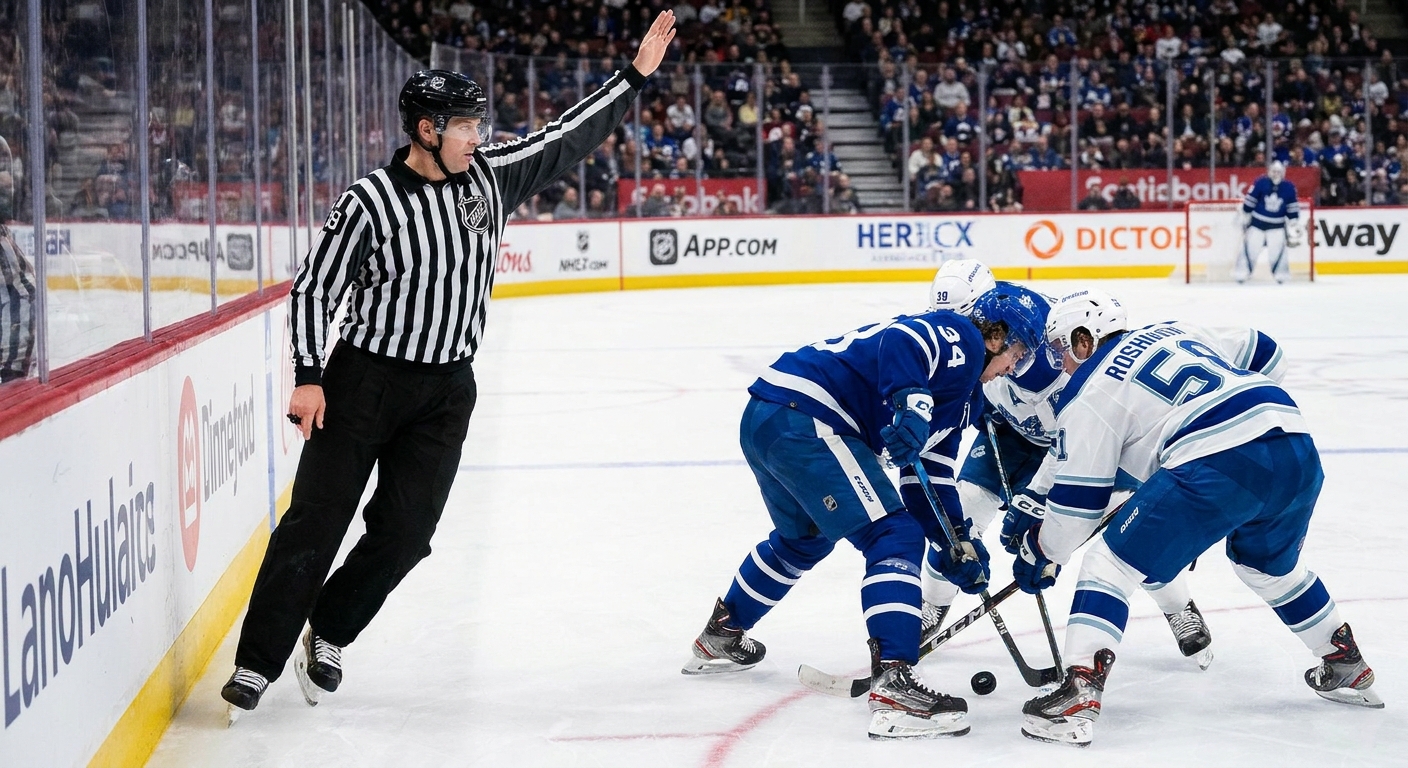
- Arm raised straight up: A delayed penalty is being signaled. Play continues.
- Whistle and arm comes down: The offending team has gained control. Play stops and the penalty is assessed.
If you’re in the stands, this is why you’ll sometimes see fans point to the ref’s raised arm before anyone else reacts. Once you know the signal, you can spot the delayed penalty instantly.
How teams play it
This is where the tactics show up. During the delay, the non-offending team’s priorities usually look like this:
- Keep possession at all costs. A low-percentage shot that turns into a rebound the other team can clear is not always worth it.
- Get organized like a power play. Teams often slide into familiar formations, moving the puck quickly to force coverage breakdowns.
- Use the extra attacker smartly. The sixth skater often jumps in as a puck support option high in the zone, ready to reset play.
Meanwhile, the offending team is in survival mode:
- Pressure the puck without overcommitting.
- Force a turnover so they can touch up and finally get the whistle.
- Protect the middle because teams love to hunt a quick slot chance before the stoppage.
Common questions
Is a delayed penalty the same as delayed offside or delayed icing?
No. A delayed penalty is about a foul already committed with a penalty coming, while play continues until the offending team gains control of the puck. Other “delayed” situations have different rules and different triggers.
Can the offending team shoot the puck while the ref’s arm is up?
Not in any practical way. Yes, the game is live, but the whole point of a delayed penalty is that the instant the offending team gains clear possession and control, the whistle blows. So if they actually settle the puck enough to pass, shoot, or make a play, that is usually the exact moment play gets killed.
The weird edge case, and it happens just often enough to be infamous: if the non-offending team has pulled its goalie for the extra attacker and then accidentally puts the puck into its own empty net (or fires a clearing attempt all the way back in), it counts as a goal. In other words, “free play” does not mean “no consequences.”
Can the non-offending team commit a penalty during the delay?
It can happen. If the team with possession takes a penalty of its own during the delayed call, officials sort out enforcement based on the sequence and types of penalties. The clean takeaway: do not assume the original team automatically gets a power play if they take a retaliatory penalty.
Why doesn’t the ref just blow the whistle immediately?
Because it would punish the team that got fouled. If you are attacking with possession and a defender hooks you, stopping play instantly removes your scoring chance. The delayed penalty preserves that advantage.
The quick version
- Delayed penalty = foul happens, arm goes up, play keeps going.
- Whistle comes when the offending team gains control of the puck.
- Goalie pull is common because the non-offending team has a “free play” while they possess the puck.
- If a goal is scored during the delay, a typical minor penalty is usually wiped out, while majors and some other penalties still apply.
Once you understand that one trigger, possession by the offending team, the whole thing stops feeling random and starts feeling like one of hockey’s smartest little fairness rules.