
Every transfer story has that same heartbeat moment: the schedule is out, the opener is circled, and the big question hits like a full-court press: When do I actually have to be enrolled to play?
This is where a lot of athletes and families get tripped up, because there are three different clocks running at once.
- The transfer portal clock (when you can enter and talk to schools)
- The practice clock (when your team can start countable activities)
- The eligibility clock (when you are allowed to compete in games)
This page is about the third one: the enrollment and certification cutoff that determines whether a transfer can suit up for the next season.
The short answer
At the simplest level, a transfer athlete generally must be officially enrolled at the new school in the required academic status and have their eligibility certified by the school before appearing in any competition.
One quick definition that helps: certified means the institution has formally signed off that you meet NCAA, conference, and school requirements and can be placed on the eligible squad list for that contest.
That sounds obvious. The messy part is what counts as “enrolled,” and what “cleared” really means in the real world, because it involves both the registrar and the athletics compliance office, and the details can vary by division (DI, DII, DIII), sport, conference, and whether you are an undergrad or grad transfer.
What this covers
This is an NCAA-focused explainer of the practical question most families are really asking: what has to be true before game day so you are allowed to compete.
It does not replace division, conference, or school-specific advice. There are meaningful differences by sport, DI versus DII versus DIII, and undergraduate versus graduate pathways. Midyear and summer enrollment can also get tricky because schools define terms differently, credit loads can change, and financial aid and progress timing can shift.
Portal vs practice vs eligibility
1) The portal window is not an enrollment deadline
Entering the portal initiates the transfer notification process and permits recruiting contact under portal rules. It does not automatically mean you are eligible at your next school, and it does not set your competition timeline by itself.
2) Practice timing is a different rule set
Teams have sport-specific rules for when countable athletically related activities can begin, and schools also have their own policies for when a transfer can join workouts, meetings, or voluntary activities.
Important caution: what a transfer can do with a team before certification is very fact-specific. Depending on admissions status, enrollment status, medical clearance, team policies, and NCAA rules around workouts and CARA, some athletes are limited to conditioning or no team activity at all until certain boxes are checked. Always confirm with compliance before assuming you can participate in anything beyond what is explicitly permitted.
3) Enrollment and certification decide game eligibility
The competition question usually comes down to this: Are you enrolled as a student in the required status, and has the school certified you as eligible under NCAA and conference rules?

What enrolled means
Schools generally care about matriculation, meaning you have actually become a student at the institution, not just committed on social media or taken a visit.
In day-to-day terms, enrolled usually means:
- You have been admitted by the institution (not just offered).
- You have registered for classes in the term tied to your participation.
- Holds are cleared so registration remains valid.
- You are attending during an official academic term, or you are enrolled in an institutionally recognized summer term when applicable.
In many NCAA situations, athletes must also be full-time to compete. There are exceptions (final-term situations, certain graduate structures, and other edge cases), so treat full-time as the default, then confirm your exact requirement with compliance and your academic advisor.
If the registrar still shows you as not registered, withdrawn, or not in the required status for your situation, that is where eligibility problems start.
The real cutoff
Here’s the part I always emphasize when I talk to families at youth tournaments and high school gyms: you will not be allowed to compete until you are certified, so if certification is not complete by game day, you sit.
Coaches can want you. Teammates can lobby for you. The rulebook does not care.
So instead of obsessing over one universal national date, treat the competition cutoff like this:
- You must be enrolled and certified before the first competition in which you want to participate.
- The earlier you enroll, the more time compliance has to clear you and fix issues like missing transcripts or an unfinished eligibility review.
Some schools also have internal deadlines tied to roster certification, conference paperwork, travel lists, and eligibility checks that make the practical deadline earlier than the first game.
Real-world example I have seen: a transcript hits the new school on a Thursday, the credit evaluation does not finalize until Monday, the compliance certification and squad list update comes Tuesday, and that Saturday opener is already gone. Nobody did anything “wrong.” The clock just ran out.
Registrar checklist
The registrar is the “you are actually a student here” gatekeeper. Before you can play, you generally need your student record to show you are admitted, registered, and in the required academic status.
Common registrar items that need to be completed:
- Final admission decision posted (including any conditional admission requirements).
- Official transcripts received from prior schools (and sometimes high school, depending on the pathway).
- Transfer credit evaluation started or completed, especially if you are close to progress-toward-degree benchmarks (primarily a DI and DII concept).
- Course registration complete for the term in which you will compete.
- Enrollment status confirmed (full-time in many cases, with limited exceptions).
- No administrative holds that invalidate registration (immunization, billing, disciplinary holds, and similar issues).
One of the most common hidden setbacks is a transcript that was “sent” but not considered official by the receiving institution because of the delivery method, missing seals, or a mismatch with what the school will accept.
Compliance checklist
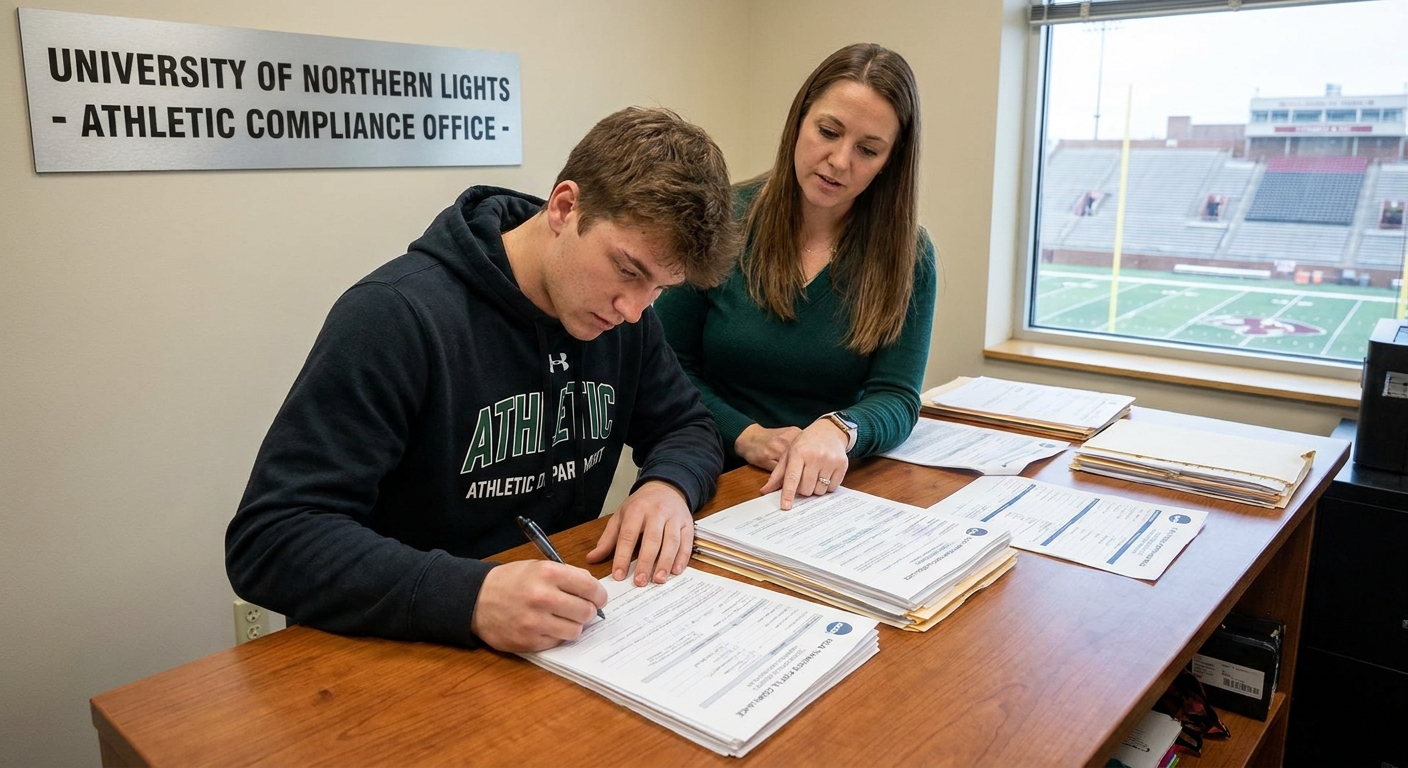
Compliance is the “you are eligible under the rules” gatekeeper. Even if you are fully enrolled, compliance still has to certify you for competition.
In most transfer situations, compliance will be working through items like these (process varies by division, sport, and whether you are an undergraduate or graduate transfer):
- Transfer eligibility review (NCAA rules, conference rules, and school policy).
- Academic eligibility certification, including progress-toward-degree where applicable (especially DI and DII).
- Financial aid and amateurism related checks, where applicable. These are often institutional, conference, or NCAA process items depending on division and pathway, and they can still affect whether you are cleared for competition.
- Previous school paperwork, which can include participation history and good standing information, depending on the situation.
- Eligibility Center items when applicable. The NCAA Eligibility Center plays a different role depending on division and whether you are initial-eligibility versus a transfer.
- Team and roster certification so your name can legally appear on an active list for competition.
Here’s the blunt truth from years of covering this: compliance cannot certify what they cannot document. If one piece is missing, the whole process slows down.
Medical clearance
This is the other gate that surprises people. Even if your enrollment and eligibility review are moving, you can still be held out if your medical file is not complete.
Common bottlenecks include pre-participation physical requirements, insurance documentation, completed medical history forms, required education modules, and any testing or documentation the school requires for participation. Policies vary by institution and sport, so treat this as a standard checklist item to knock out early, not something you wait to “handle when you get there.”
Why enrolled is not enough
I have seen this play out in real time: a player moves in, goes to workouts, posts the new jersey, and still cannot dress on game day.
That usually happens because one of these is true:
- Enrollment is not in the required status (often full-time, but not always).
- Credits did not transfer as expected, creating a progress-toward-degree issue (most common in DI and DII).
- A required form or academic record is missing from the previous institution.
- The athlete is awaiting a waiver decision or conference clearance, where applicable.
- Practice participation was permitted under a limited set of conditions, but competition certification was not complete.
The fix is almost always paperwork, patience, and making sure the athlete is talking to the right people at the right times.
Timing tips
- Ask one direct question early: “What is the latest date I must be certified to play game one?” Not “enrolled,” certified.
- Get official transcripts moving immediately, and confirm receipt on the new school’s end.
- Register early and do not churn your schedule. Last-minute drops and adds can trigger eligibility re-checks.
- Keep everything in writing (email confirmations, transcript receipts, admissions checklists).
- Ask how midyear enrollment changes things. Spring enrollment for a fall sport, or fall enrollment for a spring sport, can create timing and credit-load issues that look different by division and conference.
- Do not assume summer enrollment equals fall eligibility. Summer can be its own term with its own credit rules, and it can interact with aid timing and academic benchmarks in ways that differ by school. Ask compliance how summer counts in your exact scenario.
FAQ
Is there one universal NCAA enrollment date?
There is not one single date that fits every athlete, sport, division, and conference. The practical standard is that you must be enrolled and fully certified before you compete, and schools often set internal deadlines to ensure certification can happen in time.
If I enrolled after the term started, can I still compete?
Sometimes, but it depends on whether the institution recognizes your enrollment as valid for that term and whether compliance can certify you under NCAA and conference rules. Late adds can create credit-load issues and delays in certification.
Does being in the portal mean I’m eligible right away?
No. The portal is about permission to be contacted and the transfer process. Eligibility to compete requires enrollment plus compliance certification at the new school.
Can I practice before I’m fully cleared to compete?
Sometimes, but it is highly fact-specific. Some activities may be restricted until admissions, enrollment, medical clearance, and eligibility steps are complete. The safe rule is this: do not assume you are allowed to participate in anything athletically related until compliance tells you what is permitted.
Who gives the real answer at my new school?
Start with the athletic compliance office for eligibility and the registrar or admissions office for enrollment status. Coaches can help coordinate, but compliance and the registrar are the people who control the green light.
The bottom line
If you take nothing else from this, take this: portal entry is step one, but enrollment plus certification is the finish line.
To compete next season, a transfer athlete typically needs to be officially enrolled in a valid academic status and certified by compliance before the first contest they want to play. Handle registrar tasks early, get documents in clean and official, and give compliance time to do the job the right way. That is how you avoid the worst feeling in sports: being healthy, ready, and stuck in street clothes when the lights come on.